Ansible infra.mecm_ops Collection: Emergency Patching and Health Report Roles
By Luca Berton · Published 2024-01-01 · Category: troubleshooting
How the new infra.mecm_ops collection wraps microsoft.mecm into validated roles for emergency patching and MECM client health reporting on AAP 2.7.
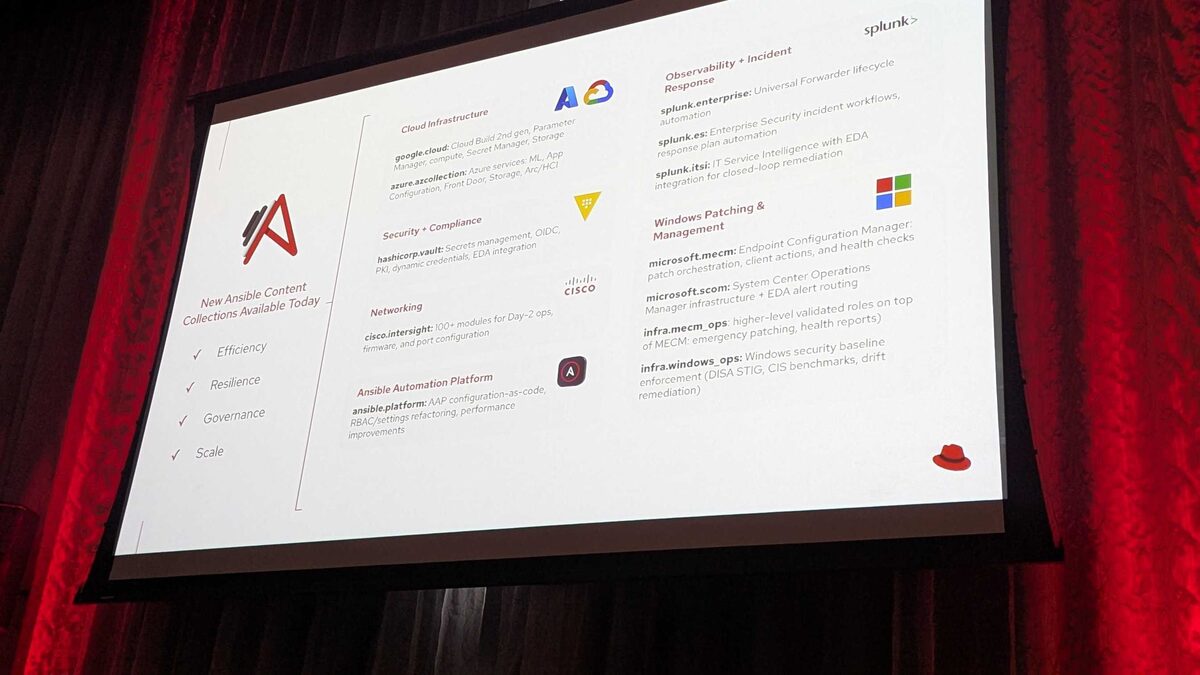
!New Ansible Content Collections Available Today — Red Hat Tech Day Netherlands 2026
Introduction
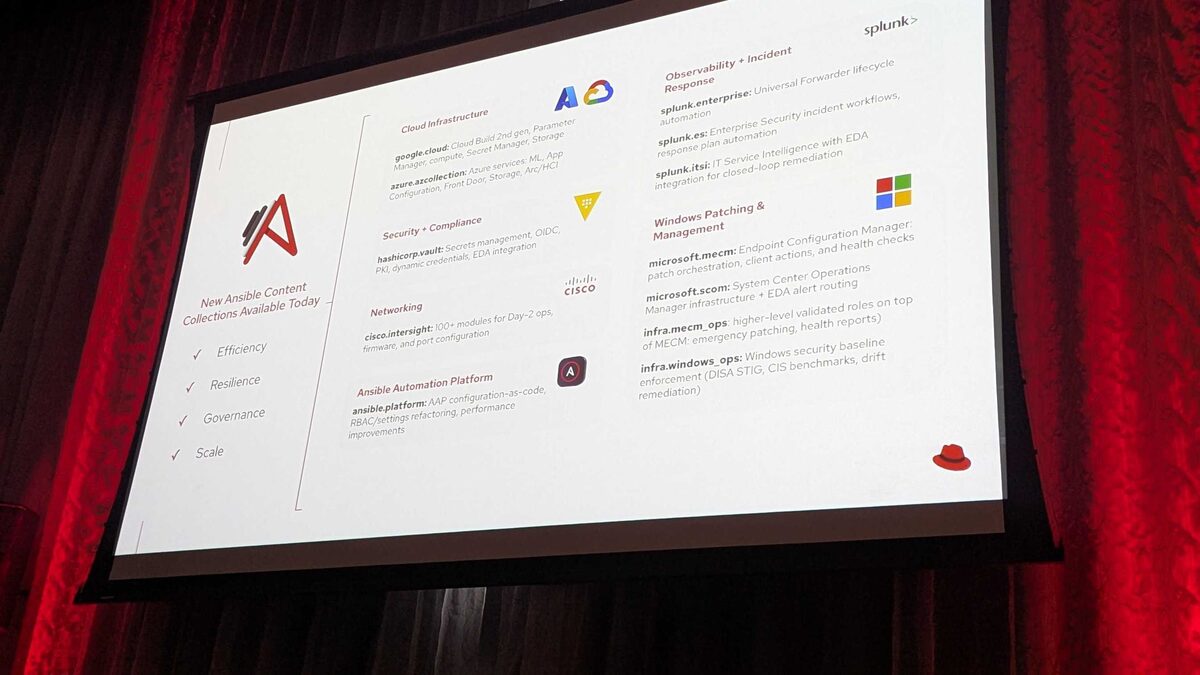
At Red Hat Tech Day Netherlands 2026 (Bunnik, 3 June 2026), the Ansible team unveiled 12 new content collections for Ansible Automation Platform 2.7, organized around four themes: Efficiency, Resilience, Governance, and Scale. Among the Windows-focused additions were two paired collections: microsoft.mecm, a foundational collection exposing Microsoft Endpoint Configuration Manager operations, and infra.mecm_ops, a higher-level collection of validated roles built on top of it. This article focuses on infra.mecm_ops — specifically its emergency patching and health report roles — and explains how it fits into a broader MECM automation strategy on AAP 2.7.
See also: Ansible microsoft.mecm Collection: Automating Endpoint Configuration Manager Patching
Why a "validated roles" layer on top of microsoft.mecm
microsoft.mecm gives automation teams module-level primitives for patch orchestration, client actions, and health checks against Microsoft Endpoint Configuration Manager (formerly SCCM). That's powerful, but module-level automation still requires every team to design its own patching sequence, error handling, reporting format, and rollback logic.
infra.mecm_ops addresses that gap the same way Red Hat's other infra.* collections do elsewhere in the ecosystem (mirrored by infra.windows_ops for STIG/CIS baseline work announced at the same event): it packages opinionated, tested roles that consume the underlying resource collection and produce consistent, auditable outcomes. Instead of hand-rolling a patch cycle every time, teams call a role, pass a handful of variables, and get a validated workflow plus a standardized report artifact.
The two flagship roles
At announcement time, Red Hat highlighted two role categories in infra.mecm_ops:
- Emergency patching — a role designed to push out-of-band, high-priority patches (think zero-day CVE remediation) to targeted MECM device collections outside the normal maintenance window, with built-in staging, compliance polling, and failure isolation.
- Health reports — a role that queries MECM client health status across a device collection and emits a structured summary suitable for dashboards, ServiceNow tickets, or Splunk ITSI ingestion (itself one of the 12 announced collections, with EDA integration for closed-loop remediation).
See also: AAP 2.7 EE Builder Step 1: Choosing a Base Image
Example: emergency patching playbook
Because infra.mecm_ops was newly announced at Tech Day Netherlands rather than shipped with full public API documentation, the following example illustrates the expected shape of a role-based playbook rather than a verbatim reference. Treat task and variable names as representative.
---
- name: Emergency out-of-band patch deployment via infra.mecm_ops
  hosts: mecm_site_servers
  gather_facts: false
  vars:
    mecm_ops_collection_name: "CVE-2026-EmergencyRing"
    mecm_ops_patch_kb_list:
      - "KB5041234"
    mecm_ops_deployment_deadline_minutes: 60
    mecm_ops_max_parallel_percent: 25
    mecm_ops_require_reboot: true
    mecm_ops_fail_fast: true

  roles:
    - role: infra.mecm_ops.emergency_patch
      vars:
        mecm_ops_notify_on_failure: true
        mecm_ops_report_format: json

  post_tasks:
    - name: Persist emergency patch run summary
      ansible.builtin.copy:
        content: "{{ mecm_ops_patch_summary | to_nice_json }}"
        dest: "/var/log/mecm_ops/{{ mecm_ops_collection_name }}-summary.json"
      delegate_to: localhost
A companion health report call typically follows the same pattern, but returns compliance and client-agent status instead of triggering a deployment:
---
- name: Generate MECM client health report
  hosts: mecm_site_servers
  gather_facts: false
  vars:
    mecm_ops_target_collection: "AllWindowsWorkstations"
    mecm_ops_report_recipients:
      - itops-alerts@example.com

  roles:
    - role: infra.mecm_ops.health_report
      vars:
        mecm_ops_include_agent_version: true
        mecm_ops_include_last_checkin: true
How the roles compare
| Role | Trigger pattern | Primary output | Typical consumer |
|---|---|---|---|
| Emergency patching | Manual job launch or EDA rulebook on CVE alert | Deployment status per device, compliance percentage | AAP job template, incident response runbook |
| Health report | Scheduled workflow (e.g., daily/weekly) | Structured client health summary (JSON/CSV) | Splunk ITSI, ServiceNow, management dashboards |
microsoft.mecm supplies the raw capability (patch orchestration, client actions, health checks), while infra.mecm_ops supplies the operational discipline (validated sequencing, reporting, and thresholds) that platform teams need to trust automated, unattended runs.
See also: AAP 2.7 EE Builder Step 2: Adding Collections from Private Automation Hub
Fitting infra.mecm_ops into an AAP 2.7 strategy
Because infra.mecm_ops is designed for AAP 2.7, it benefits from platform-level capabilities announced alongside it, including the ansible.platform collection's configuration-as-code and RBAC refactoring. In practice that means:
- Job templates for the emergency patching role can be gated behind tightened RBAC so only designated on-call automation engineers can launch out-of-band patch cycles.
- Health report runs can be scheduled as recurring workflows and their outputs routed into Splunk ITSI or ServiceNow for closed-loop tracking.
- Emergency patching can be wired to Event-Driven Ansible so a vulnerability signal — from
hashicorp.vault-managed secrets rotation events, a Splunk ES incident workflow, or an internal alert source — kicks off the role automatically rather than waiting for a human to launch it.
Key Takeaways
infra.mecm_opsis one of 12 new content collections for AAP 2.7 announced at Red Hat Tech Day Netherlands 2026 (3 June 2026, Bunnik).- It provides higher-level, validated roles — notably emergency patching and health reports — built on the foundational
microsoft.mecmcollection. - The emergency patching role targets out-of-band, high-priority remediation scenarios such as zero-day CVE response, with staged rollout and compliance tracking.
- The health report role produces structured MECM client health summaries suited for dashboards and ITSM/SIEM ingestion, including Splunk ITSI.
- Pairing
infra.mecm_opswith AAP 2.7's RBAC improvements and Event-Driven Ansible enables automated, auditable, and access-controlled Windows patch operations at scale.
Conclusion
infra.mecm_ops represents a broader pattern in Red Hat's 2026 content strategy: pair a foundational, resource-level collection with an opinionated, validated-roles collection that encodes operational best practice. For Windows and MECM-heavy shops, that means emergency patching and health reporting no longer live as bespoke scripts or manual console workflows — they become first-class, governable AAP job templates and EDA-triggered automations.
Related Articles
- Ansible microsoft.mecm Collection: Automating Endpoint Configuration Manager Patching
- Ansible infra.windows_ops Collection: DISA STIG and CIS Benchmark Drift Remediation
- Build an AAP Self-Service Template: RHEL Patch Servers Maintenance Window
- Build an AAP Self-Service Template: Emergency CVE Patch Playbook
Category: troubleshooting