Ansible Error 'Use loop or with_': Fix Deprecated with_items Syntax
By Luca Berton · Published 2024-01-01 · Category: installation
Fix Ansible deprecation error about loop vs with_items. Migrate from with_items, with_dict, with_nested to modern loop syntax with practical before/after.
Introduction
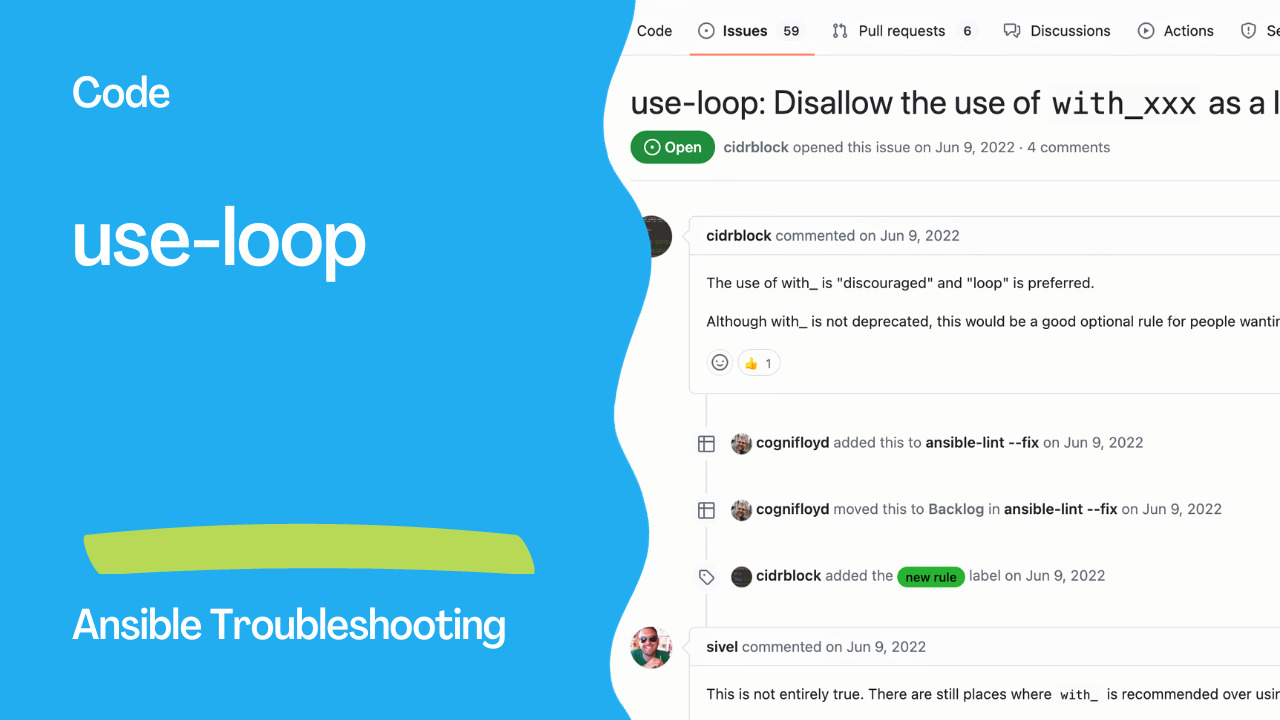
Ansible, a powerful IT automation tool, continually evolves to improve the efficiency and readability of playbooks. One such evolution is the introduction of the use-loop rule in Ansible Lint, aiming to discourage the use of with_xxx as a looping mechanism in favor of the more versatile loop.
The Rule in Action
The use-loop rule emphasizes the preference for the loop construct over the older with_xxx syntax. While the latter is not deprecated, adopting the loop syntax is encouraged for a future-proof playbook.
When applied, the rule generates messages highlighting instances where with_xxx is used for looping, nudging developers towards the more modern and flexible loop alternative. For example, it may produce warnings such as:
use-loop[play]: The play uses strategy: free.use-loop[task]: Usingrun_oncemay behave differently if the strategy is set to free.
Understanding the Motivation
The use-loop rule aligns with Ansible's commitment to staying current and streamlining syntax for better code maintenance. By discouraging the use of with_xxx in favor of loop, the rule prompts users to embrace a more uniform and expressive approach to looping in playbooks.
Community Dialogue
The introduction of this rule sparked discussions within the Ansible community. Some contributors expressed concerns about the rule being controversial, as the preference between with_xxx and loop can be subjective and dependent on individual taste and style. The rule's default inclusion in the production profile was also debated, with suggestions to make it optional to accommodate diverse preferences.
Real-World Considerations
In the discussions, real-world examples were raised to illustrate scenarios where the with_xxx syntax might be more readable or efficient than its loop counterpart. The community emphasized the need for a comprehensive list of examples to guide the implementation of this rule effectively.
Future Implications
While the use-loop rule is currently an opt-in feature, its potential inclusion in default profiles and the ongoing discussions within the Ansible community highlight the importance of staying informed about evolving best practices in playbook development.
Links
- https://github.com/ansible/ansible-lint/issues/2204
Conclusion
As Ansible evolves, so do its best practices. The use-loop rule in Ansible Lint is a testament to the community's commitment to enhancing playbook readability and maintainability. Users are encouraged to engage in discussions, share real-world examples, and adapt to emerging conventions to create efficient and future-proof Ansible playbooks.
See also: Publishing Ansible Collections to Ansible Galaxy and Automation Hub
The Fix
Replace deprecated with_* syntax with modern loop:
# OLD (deprecated)
- name: Install packages
  apt:
    name: "{{ item }}"
  with_items:
    - nginx
    - curl

# NEW (modern)
- name: Install packages
  apt:
    name: "{{ item }}"
  loop:
    - nginx
    - curl
Migration Examples
with_items → loop
# Before
- debug: msg="{{ item }}"
  with_items: "{{ my_list }}"

# After
- debug: msg="{{ item }}"
  loop: "{{ my_list }}"
with_dict → loop + dict2items
# Before
- debug: msg="{{ item.key }}={{ item.value }}"
  with_dict: "{{ my_dict }}"

# After
- debug: msg="{{ item.key }}={{ item.value }}"
  loop: "{{ my_dict | dict2items }}"
with_nested → loop + product
# Before
- debug: msg="{{ item.0 }}-{{ item.1 }}"
  with_nested:
    - [a, b]
    - [1, 2]

# After
- debug: msg="{{ item.0 }}-{{ item.1 }}"
  loop: "{{ ['a','b'] | product([1,2]) | list }}"
with_fileglob → loop + fileglob lookup
# Before
- copy: src="{{ item }}" dest=/etc/configs/
  with_fileglob: "files/*.conf"

# After
- copy: src="{{ item }}" dest=/etc/configs/
  loop: "{{ lookup('fileglob', 'files/*.conf', wantlist=True) }}"
with_sequence → loop + range
# Before
- debug: msg="user{{ item }}"
  with_sequence: start=1 end=5

# After
- debug: msg="user{{ item }}"
  loop: "{{ range(1, 6) | list }}"
with_subelements → loop + subelements
# Before
- debug: msg="{{ item.0.name }}-{{ item.1 }}"
  with_subelements:
    - "{{ users }}"
    - groups

# After
- debug: msg="{{ item.0.name }}-{{ item.1 }}"
  loop: "{{ users | subelements('groups') }}"
See also: Ansible troubleshooting - Error parser-error
loop_control
- name: Process with custom variable
  debug:
    msg: "{{ server.name }}"
  loop: "{{ servers }}"
  loop_control:
    loop_var: server       # Custom variable name
    label: "{{ server.name }}"  # Shorter output
    index_var: idx         # Loop counter
    pause: 1               # Delay between iterations
Quick Reference
| Old Syntax | New Syntax |
|---|---|
with_items | loop |
with_list | loop |
with_dict | loop: dict2items |
with_nested | loop: product() |
with_sequence | loop: range() |
with_fileglob | loop: fileglob lookup |
with_subelements | loop: subelements() |
with_together | loop: zip() |
with_indexed_items | loop + loop_control.index_var |
FAQ
Is with_items completely removed?
Not yet — it's deprecated and will show warnings. It still works but should be migrated to loop for forward compatibility.
Can I pass a list directly to modules?
Many modules accept lists natively (faster than looping):
# Better than loop — single transaction
- apt:
    name:
      - nginx
      - curl
      - git
    state: present
See also: ARA Records Ansible: Playbook Reporting & History (Complete Guide)
Related Articles
Category: installation