Ansible troubleshooting - Error 305: command-instead-of-shell
By Luca Berton · Published 2024-01-01 · Category: troubleshooting
"How to Solve Ansible Error 305: command-instead-of-shell - A troubleshooting guide."
Introduction
Ansible, the popular automation tool, provides a powerful platform for managing and configuring IT infrastructure efficiently. While Ansible offers various modules to execute tasks, it's crucial to choose the right module for specific use cases. Ansible-Lint, a widely-used linting tool for Ansible playbooks, enforces rules to help you follow best practices. In this article, we'll delve into Rule 305, "command-instead-of-shell," in Ansible-Lint which encourages the use of the command module over the shell module when it's not necessary to employ shell features.
See also: Ansible troubleshooting - Error 102: No Jinja2 in 'when' Conditions
Understanding Rule 305
Rule 305, "command-instead-of-shell," is a valuable guideline that promotes efficiency and best practices in Ansible playbooks. It suggests that the command module should be preferred over the shell module unless specific shell features, such as environment variable expansion or chaining multiple commands using pipes, are required.
Problematic Code
Let's explore a piece of problematic code that Rule 305 can identify in your playbooks:
---
- name: Problematic example
  hosts: all
  tasks:
    - name: Echo a message
      ansible.builtin.shell: echo hello # <-- command is better in this case
      changed_when: false
In this code snippet, the playbook utilizes the shell module (ansible.builtin.shell) to execute a simple command that echoes a message. While this code will work, it's not the most efficient or recommended approach.
Output:
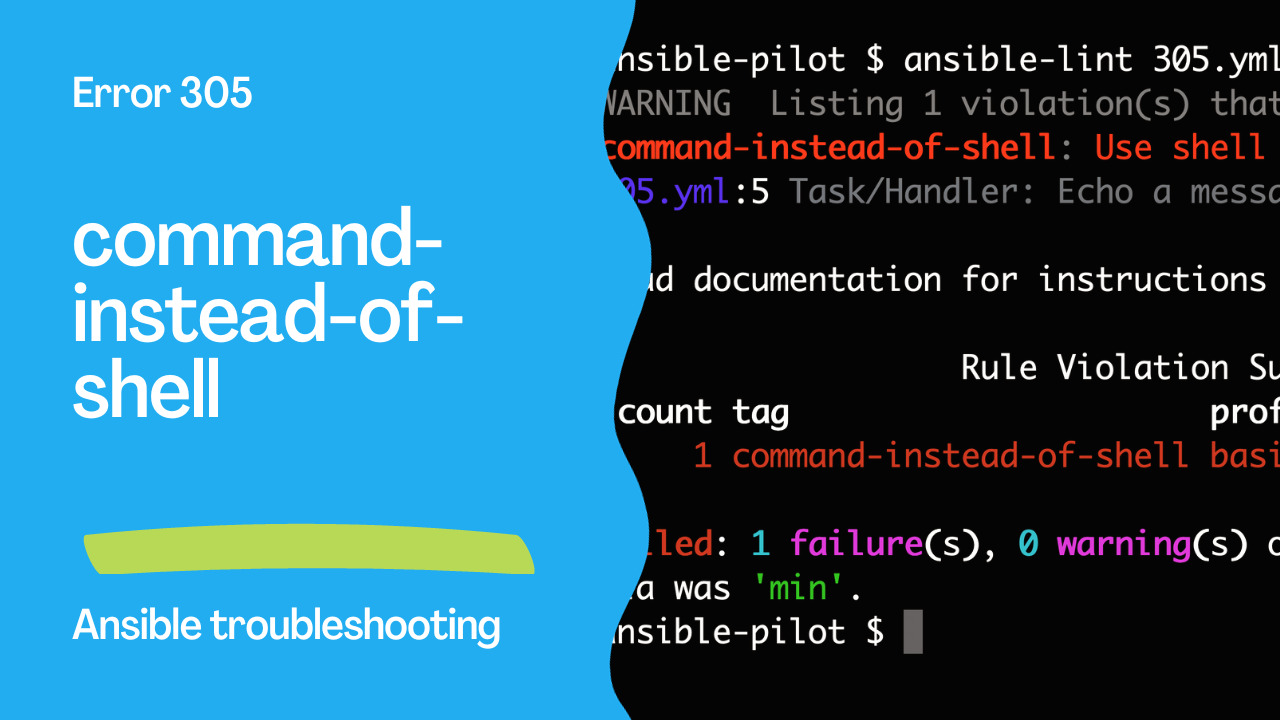
WARNING  Listing 1 violation(s) that are fatal
command-instead-of-shell: Use shell only when shell functionality is required.
305.yml:5 Task/Handler: Echo a message

Read documentation for instructions on how to ignore specific rule violations.

                   Rule Violation Summary
 count tag                      profile rule associated tags
     1 command-instead-of-shell basic   command-shell, idiom

Failed: 1 failure(s), 0 warning(s) on 1 files. Last profile that met the validation criteria was 'min'.
See also: Ansible troubleshooting - Error 104: Deprecated Bare Vars
Correct Code
The corrected code that adheres to Rule 305 is as follows:
---
- name: Correct example
  hosts: all
  tasks:
    - name: Echo a message
      ansible.builtin.command: echo hello
      changed_when: false
In this improved version, the command module (ansible.builtin.command) is used to execute the same "echo" command. This approach aligns with best practices and is more efficient.
Why Choose the Command Module Over the Shell Module
The command module is preferred over the shell module in many cases due to several advantages:
- Efficiency: The command module is considerably faster than the shell module, making your playbooks run more quickly.
- Predictability: Using the command module ensures more predictable and reliable execution, as it doesn't involve shell-specific behavior.
- Idempotence: The command module is idempotent by design, meaning it only makes changes when necessary, enhancing playbook reliability.
- Security: By avoiding unnecessary shell access, you reduce potential security risks and vulnerabilities.
Exception Handling
While Rule 305 encourages the use of the command module, there may be situations where you genuinely need the features offered by the shell module. In such cases, it's essential to carefully consider whether the use of shell features justifies the performance trade-off. If you find that the shell module is indeed necessary, you can continue using it with an understanding of the potential efficiency implications.
See also: Ansible troubleshooting - Error 105: Deprecated Module Usage
Conclusion
Rule 305, "command-instead-of-shell," is a valuable guideline within Ansible-Lint that promotes efficiency and best practices in Ansible playbooks. By choosing the command module over the shell module when shell-specific features are not required, you can enhance the speed, predictability, and reliability of your automation tasks. This practice contributes to a more efficient and secure Ansible workflow, ultimately ensuring that your playbooks perform optimally and effectively manage your IT infrastructure.
Related Articles
Category: troubleshooting