Learn Ansible: Complete Beginner's Guide & Learning Path (2026)
By Luca Berton · Published 2024-01-01 · Category: installation
How to learn Ansible from scratch. Step-by-step learning path, free resources, hands-on labs, and certification guide for beginners and experienced admins.
Introduction
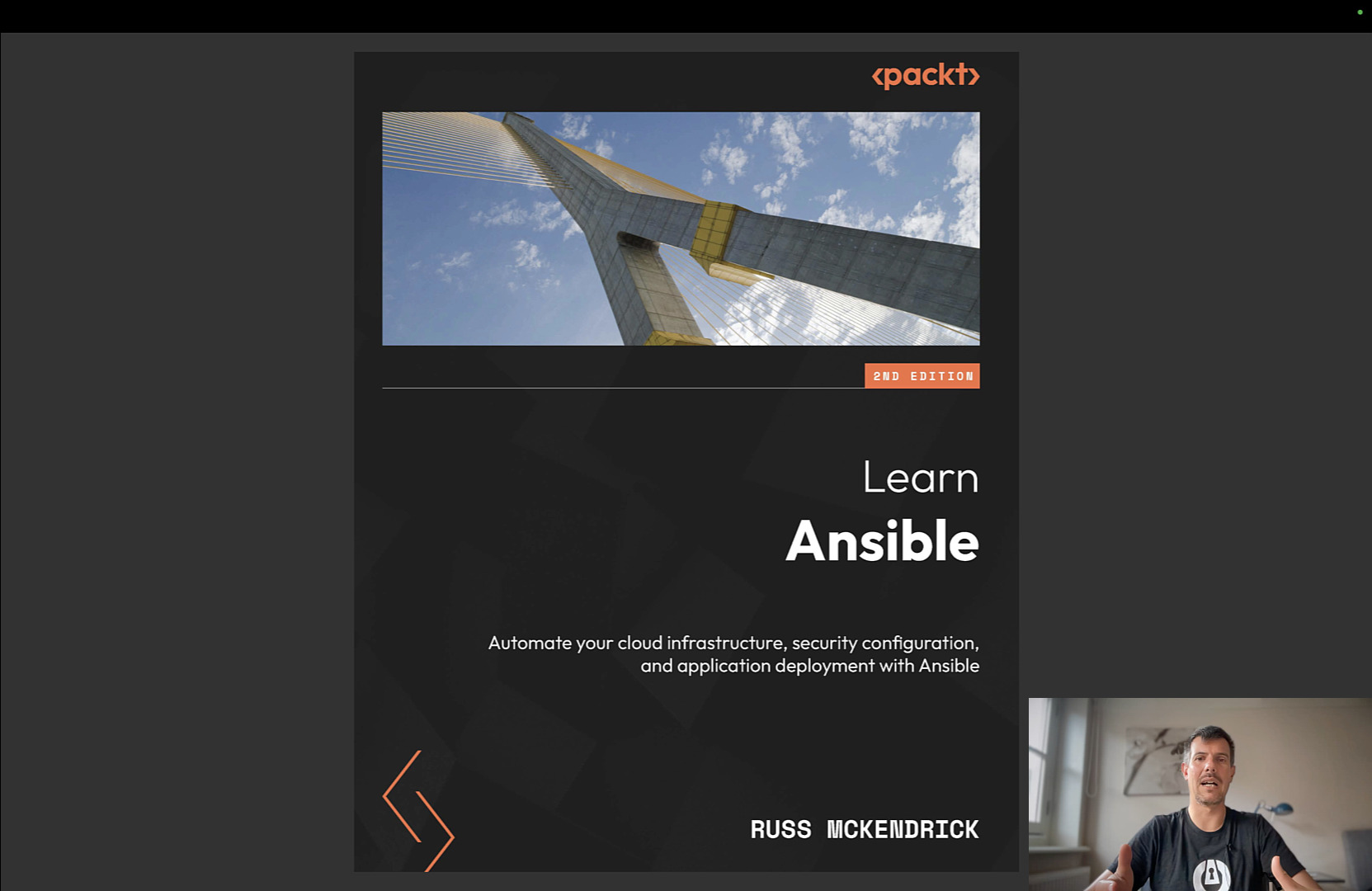
Learn how to write and run Ansible Playbooks, from the basics to launching complex multi-tier applications across public cloud platforms such as Amazon Web Services (AWS) and Microsoft Azure.
 {{< LearnAnsible >}}
See also: ansible_date_time: Access Date, Time & Timestamp Facts in Ansible
Key Features
- Write roles to automate everything, from basic apps to the entire cloud infrastructure
- Leverage Ansible's module ecosystem to streamline tasks across cloud platforms, operating systems, and apps
- Adopt DevOps practices and integrate Ansible with CI/CD platforms to streamline automation workflows
Book Description
Are you tired of manually deploying and managing your infrastructure and looking for ways to streamline your deployments, introduce consistency and collaboration, and save time? If so, then Learn Ansible is for you. Written by a DevOps practitioner and system administrator with 30] years of experience, this book will teach you how to automate repetitive tasks and effortlessly manage several resources from a single code base.
From installing Ansible and writing your first playbook to deploying multi-tier applications across different cloud platforms, this book will take you on an exciting learning journey. By learning the art of defining highly available cloud infrastructure using code, you'll find it easy to distribute configurations alongside your application. You'll explore Ansible Galaxy, learn about community-contributed Ansible roles, and discover how to create and share your own roles. Later, the book delves into the capabilities of Ansible AWX and integrating Ansible with your CI/CD pipelines, using Azure DevOps and GitHub Actions. With real-world examples and hands-on tutorials, you'll build a solid foundation to tackle any automation project.
By the end of this book, you'll be able to confidently implement Ansible in your environment and day-to-day workflows, taking your deployments to the next level.
What you will learn
- Understand how to install and configure Ansible on Linux, macOS, and Windows
- Write Ansible playbooks to automate system configuration and deployment
- Deploy applications such as LAMP stacks and WordPress using Ansible
- Create reusable roles and use Ansible Galaxy for sharing
- Automate infrastructure deployments on cloud platforms such as AWS and Azure
- Execute your Ansible playbooks with GitHub Actions and Azure DevOps
- Scan playbooks for security issues and secure systems using Ansible
- Centralize and manage Ansible deployments using Ansible AWX
Who this book is for
Learn Ansible is for system administrators, developers, and infrastructure engineers who want to implement infrastructure automation and configuration management using Ansible. The hands-on tutorials make this book ideal for both beginners as well as intermediate users looking to take their Ansible skills to the next level. Technology professionals working with public cloud platforms like AWS and Azure will also find valuable insights into automating deployments.
{{< LearnAnsible >}}
See also: Ansible Troubleshooting: Fix Missing amazon.aws.ec2_ami_info
Author Bio
Russ McKendrick is an experienced DevOps practitioner and system administrator with a passion for automation and containers. He has been working in IT and related industries for the better part of 25 years. During his career, he has had varied responsibilities in many different sectors, ranging from looking after an entire IT infrastructure to providing first-line, second-line, and senior support in both client-facing and internal teams for small and large organisations.
He works almost exclusively with Linux, using open source systems and tools across both dedicated hardware and virtual machines hosted in public and private clouds at N4Stack which is a Node4 company, where he is the Practice Manager of SRE & DevOps.
In his spare time, he has written seven books "Monitoring Docker", "Extending Docker", "Docker Bootcamp", "Mastering Docker - Second Edition", "Kubernetes for Serverless Applications", "Learn Ansible" and has contributed to "Docker High Performance - Second Edition" which are all available now.
He has also contributed to "Monitoring and Management With Docker and Containers", which was published by The New Stack. His seventh book, "Mastering Docker - Third Edition", has just been published by Packt Publishing.
He also buys way too many records.
GitHub repo
Code is available on the following GitHub repository
- https://github.com/PacktPublishing/Learn-Ansible
See also: Ansible troubleshooting - Resolve Ansible Galaxy Role Installation Issues
Learning Path
Phase 1: Foundations (Week 1-2)
- Install Ansible on your machine
- Understand YAML syntax
- Write your first playbook (install a package, create a file)
- Learn inventory (hosts, groups, variables)
- Run ad-hoc commands (
ansible all -m ping)
Phase 2: Core Concepts (Week 3-4)
- Modules — copy, template, service, apt/yum, user, file
- Variables — defaults, group_vars, host_vars, facts
- Conditionals — when, changed_when, failed_when
- Loops — loop, with_items, with_dict
- Handlers — notify/listen pattern
- Templates — Jinja2 basics
Phase 3: Organization (Week 5-6)
- Roles — structure, defaults, dependencies
- Collections — ansible-galaxy, requirements.yml
- Vault — encrypt secrets, vault files
- Error handling — block/rescue/always, ignore_errors
Phase 4: Advanced (Week 7-8)
- Dynamic inventory — AWS, Azure, GCP plugins
- Custom filters and plugins
- Molecule testing
- AWX/AAP — web UI, scheduling, RBAC
- Event-Driven Ansible
Hands-On Lab Setup
# Minimal lab with Vagrant
vagrant init ubuntu/noble64
vagrant up

# Or with Docker
docker run -it --name ansible-lab ubuntu:24.04 bash
apt update && apt install -y python3 openssh-server

# Install Ansible on controller
pip install ansible-core
First Playbook
---
- name: My first playbook
  hosts: localhost
  connection: local
  tasks:
    - name: Create a file
      copy:
        content: "Hello from Ansible!\n"
        dest: /tmp/hello.txt

    - name: Install a package
      apt:
        name: curl
        state: present
      become: true

    - name: Show a message
      debug:
        msg: "Ansible is working!"
ansible-playbook first-playbook.ymlEssential Commands
# Run playbook
ansible-playbook site.yml

# Check mode (dry run)
ansible-playbook site.yml --check --diff

# Ad-hoc commands
ansible all -m ping
ansible web -m shell -a "uptime"
ansible db -m setup  # Gather facts

# Vault
ansible-vault create secrets.yml
ansible-vault edit secrets.yml
ansible-playbook site.yml --ask-vault-pass

# Galaxy
ansible-galaxy collection install community.general
ansible-galaxy role install geerlingguy.docker
Free Learning Resources
| Resource | Type | Level |
|---|---|---|
| docs.ansible.com | Documentation | All |
| Ansible Pilot (this site!) | Tutorials + videos | Beginner-Advanced |
| Ansible GitHub examples | Code | Intermediate |
| Jeff Geerling's YouTube | Video | Beginner |
| Red Hat Training | Courses | All |
Practice Projects
- Web server setup — Install nginx, deploy config, enable SSL
- User management — Create users, SSH keys, sudo access
- Application deployment — Git clone, build, configure, start
- Monitoring stack — Prometheus + Grafana + Node Exporter
- Docker host — Install Docker, deploy containers
- Database setup — PostgreSQL install, create DB, manage users
- Security hardening — SSH config, firewall, fail2ban
Certification Path
| Certification | Vendor | Level |
|---|---|---|
| EX374 (Ansible Best Practices) | Red Hat | Intermediate |
| EX467 (AAP) | Red Hat | Advanced |
| RHCE (includes Ansible) | Red Hat | Professional |
FAQ
How long to learn Ansible?
Basic competency: 2-4 weeks. Production-ready: 2-3 months. Expert: 6-12 months with real projects.
Do I need to know Python?
No — Ansible uses YAML. Python helps for writing custom modules/filters but isn't required for daily use.
Ansible vs Terraform — which should I learn first?
They serve different purposes. Ansible for configuration management (install, configure, manage). Terraform for infrastructure provisioning (create VMs, networks). Learn Ansible first if you're a sysadmin.
Related Articles
Category: installation
Watch the video: Learn Ansible: Complete Beginner's Guide & Learning Path (2026) — Video Tutorial