Ansible Lightspeed Review: AI-Powered Automation with IBM Watson
By Luca Berton · Published 2024-01-01 · Category: events
Discover Ansible Lightspeed with IBM Watson Code Assistant. Explore its AI-driven automation capabilities, setup guide, and how it enhances IT efficiency.
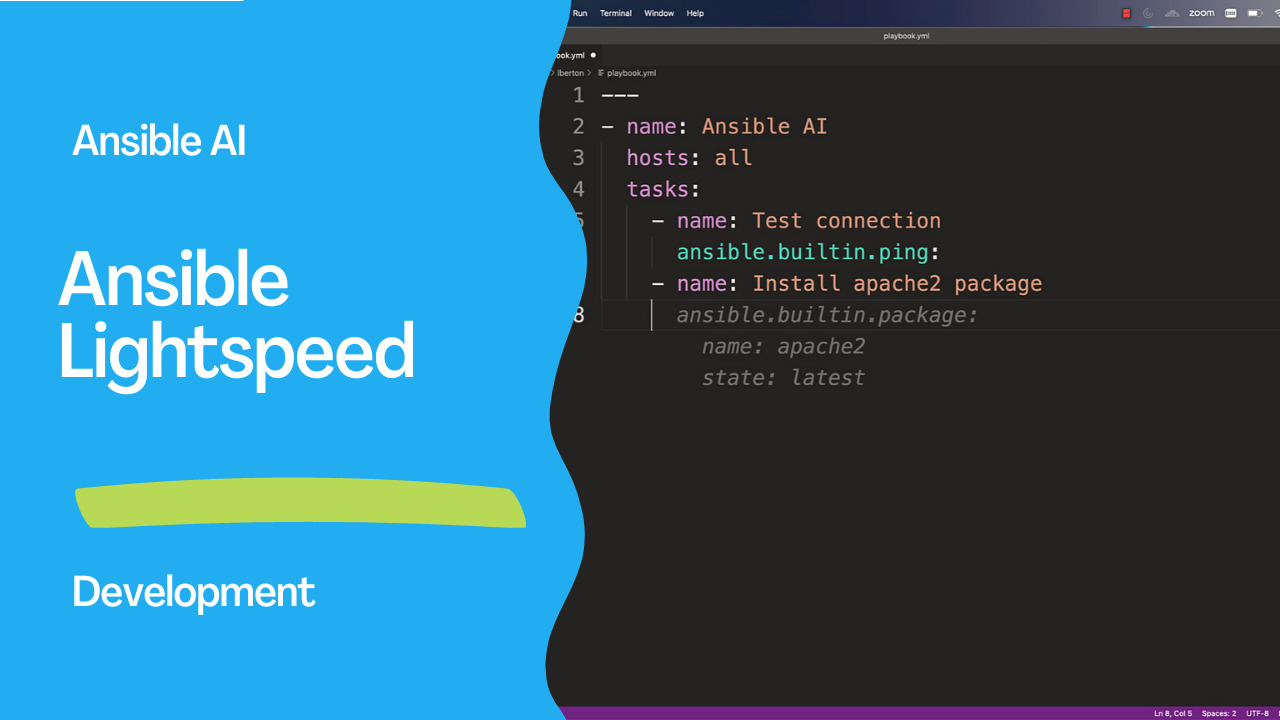
One of the major news of the Red Hat Summit 2023 and AnsibleFest worldwide event was the announcement of the Ansible Lightspeed with IBM Watson Code Assistant. It is a service that leverages artificial intelligence (AI) to assist developers in creating Ansible content more efficiently.
Ansible is an open-source automation tool used for configuration management, application deployment, and orchestration. It allows users to define and manage infrastructure as code using a simple and human-readable language.
The integration of IBM Watson Code Assistant suggests that the service utilizes IBM’s Watson AI technology, specifically the Watson foundation models. These models are pre-trained AI models developed by IBM to perform various natural language processing (NLP) tasks, such as language translation, sentiment analysis, question-answering, and more.
Generative AI has become pervasive in today’s technological landscape, offering a myriad of exciting tools and applications. However, Ansible Lightspeed with IBM Watson Code Assistant stands out by adopting a unique approach. While there are numerous AI tools designed for tasks like writing papers or emails, Ansible Lightspeed is purpose-built for IT automation, focusing on delivering a tailored generative AI experience that saves organizations time and money.
The purpose of “Ansible Lightspeed with IBM Watson Code Assistant” is to provide developers with a tool that can generate automation code recommendations in Ansible syntax based on plain English input. This means developers can enter their requirements or descriptions in English, and the service will generate Ansible Playbook code that aligns with those requirements. This can potentially save time and effort in writing Ansible code manually.
One of Ansible Lightspeed’s key objectives is to ensure that the finest content, examples, and resources take center stage for others to discover. This goes beyond merely serving up excellent automation code; the system also comprehends the user’s objectives. Building confidence and trust within the Ansible user community is a top priority, as Ansible Lightspeed aims to become a true force multiplier for automation adoption and acceleration. Ansible Lightspeed, in collaboration with IBM Watson Code Assistant, introduces a novel approach to address these challenges. Rather than manually parsing documentation and assembling code snippets, users can simply enter a task generation request and receive code recommendations that seamlessly integrate into their playbook with a single click. These recommendations originate from a reliable, automation-specific foundational data model, ensuring transparency and trust.
Previously known as Ansible Project Wisdom, the technology preview of the service is planned to be launched shortly. It is stated that this preview version will be free for Ansible users and accessible through the Ansible extension for Visual Studio Code, an integrated development environment (IDE) for coding. It’s also mentioned that an active GitHub account will be required to access the service, which suggests that there might be some integration with GitHub for code storage or collaboration purposes.
I had the opportunity to test the closed beta, and my impression is that it is a tool that can assist in the everyday development journey, even if not accurate by 100%.
Links
- https://www.redhat.com/en/technologies/management/ansible/automation-coding-assistant
- https://www.redhat.com/en/about/press-releases/red-hat-introduces-ansible-lightspeed-ai-driven-it-automation
- https://www.redhat.com/en/blog/automation-and-ai-revolution
Conclusion
Ansible Lightspeed with IBM Watson Code Assistant signifies a paradigm shift in IT automation. By combining the power of generative AI with a purpose-built approach, Ansible Lightspeed empowers organizations to accelerate their automation initiatives, optimize resource utilization, and achieve greater operational efficiency. As the automation landscape continues to evolve, the integration of Ansible Lightspeed and Event-Driven Ansible holds the promise of a seamless and transformative automation experience for the future.See also: Ansible Lightspeed Review: IBM Watson AI Enhances Development
Related Articles
Category: events
Watch the video: Ansible Lightspeed Review: AI-Powered Automation with IBM Watson — Video Tutorial