Install Red Hat OpenShift Local Kubernetes in macOS on MacBook Pro Intel x86_64 and M1 arm64
By Luca Berton · Published 2024-01-01 · Category: installation
How to install Red Hat OpenShift Local Kubernetes (formerly CodeReady Containers) to run a complete OpenShift 4 cluster in your Mac (Intel Chip x86_64 or Apple.
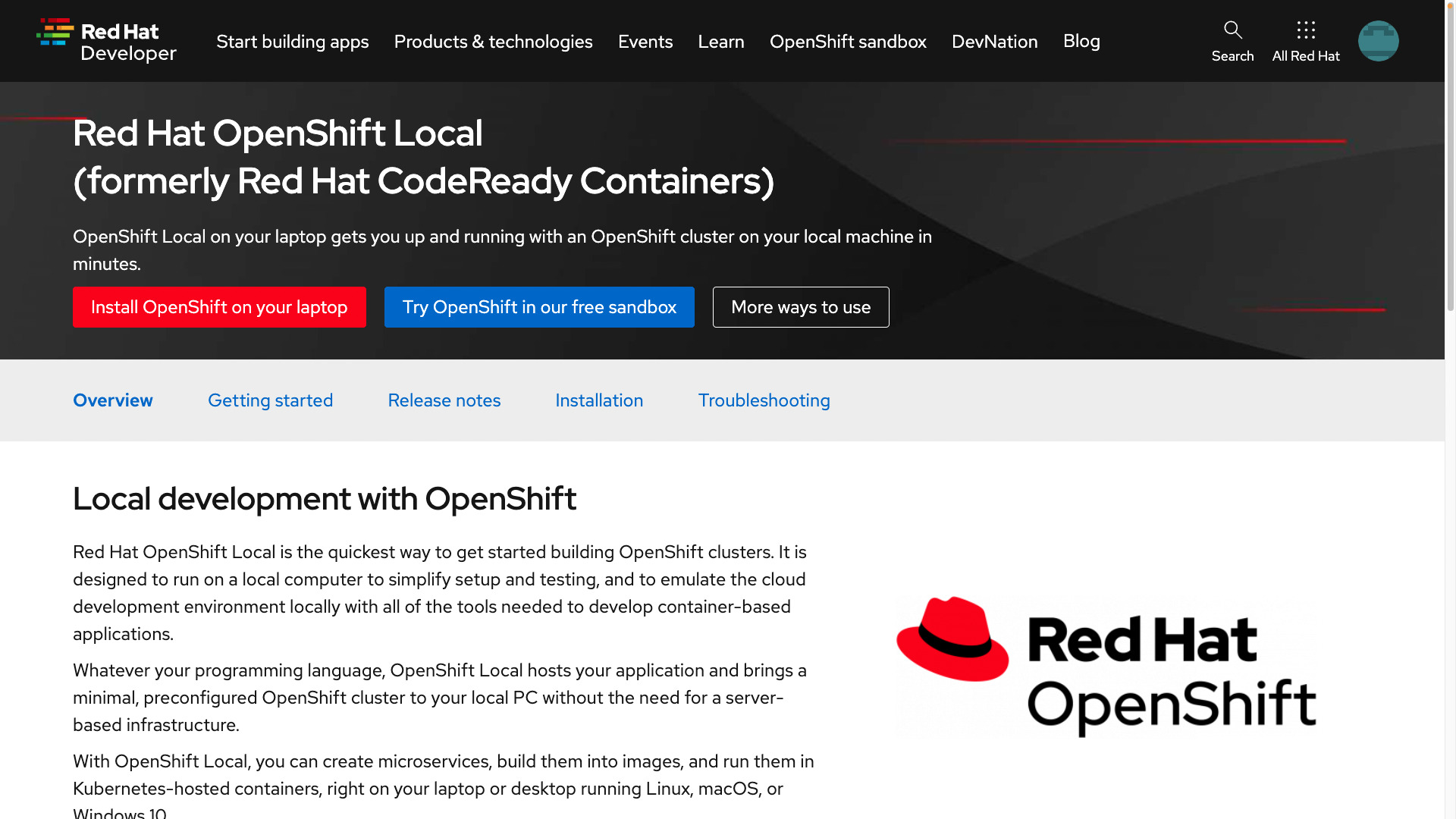
What is Red Hat OpenShift Local
• an OpenShift 4 cluster for local development • minimum 4 vCPU, 8 GB RAM, 35 GB storage • formerly CodeReady ContainersOpenShift Local is designed for local development and testing on an OpenShift 4 cluster. The OpenShift Local requires at least: • 4 virtual CPUs (vCPUs) • 8 GB of RAM memory • 35 GB of storage space
## Playbook
How to Install Red Hat OpenShift Local in MacOS and simple usage. • Red Hat OpenShift 4 on your laptop: Introducing Red Hat CodeReady Containers
cluster setup
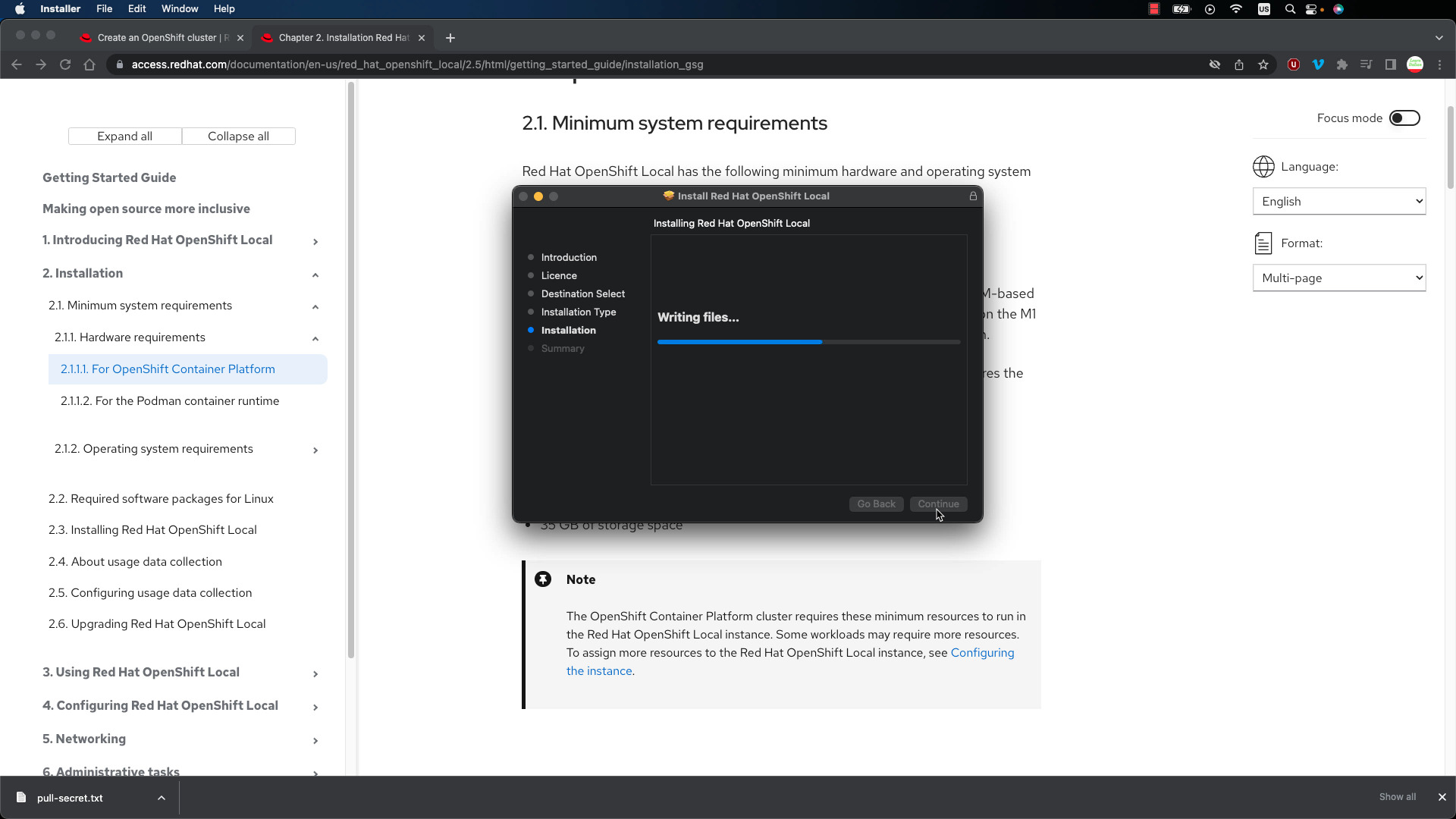
ansible-pilot $ crc setup
CRC is constantly improving and we would like to know more about usage (more details at https://developers.redhat.com/article/tool-data-collection)
Your preference can be changed manually if desired using 'crc config set consent-telemetry <yes/no>'
Would you like to contribute anonymous usage statistics? [y/N]: y
Thanks for helping us! You can disable telemetry with the command 'crc config set consent-telemetry no'.
INFO Using bundle path /Users/lberton/.crc/cache/crc_vfkit_4.11.3_arm64.crcbundle
INFO Checking if running as non-root
INFO Checking if crc-admin-helper executable is cached
INFO Checking for obsolete admin-helper executable
INFO Checking if running on a supported CPU architecture
INFO Checking minimum RAM requirements
INFO Checking if crc executable symlink exists
INFO Creating symlink for crc executable
INFO Checking if running emulated on a M1 CPU
INFO Checking if vfkit is installed
INFO Checking if CRC bundle is extracted in '$HOME/.crc'
INFO Checking if /Users/lberton/.crc/cache/crc_vfkit_4.11.3_arm64.crcbundle exists
INFO Getting bundle for the CRC executable
3.09 GiB / 3.09 GiB [--------------------------------------------------------------------] 100.00% 2.84 MiB p/s
INFO Uncompressing /Users/lberton/.crc/cache/crc_vfkit_4.11.3_arm64.crcbundle
crc.img: 31.00 GiB / 31.00 GiB [----------------------------------------------------------------------] 100.00%
INFO Checking if old launchd config for tray and/or daemon exists
INFO Checking if crc daemon plist file is present and loaded
INFO Adding crc daemon plist file and loading it
Your system is correctly setup for using CRC. Use 'crc start' to start the instance
ansible-pilot $
cluster start
ansible-pilot $ crc start
INFO Checking if running as non-root
INFO Checking if crc-admin-helper executable is cached
INFO Checking for obsolete admin-helper executable
INFO Checking if running on a supported CPU architecture
INFO Checking minimum RAM requirements
INFO Checking if crc executable symlink exists
INFO Checking if running emulated on a M1 CPU
INFO Checking if vfkit is installed
INFO Checking if old launchd config for tray and/or daemon exists
INFO Checking if crc daemon plist file is present and loaded
INFO Loading bundle: crc_vfkit_4.11.3_arm64...
INFO Starting CRC VM for openshift 4.11.3...
INFO CRC instance is running with IP 127.0.0.1
INFO CRC VM is running
INFO Configuring shared directories
INFO Check internal and public DNS query...
INFO Check DNS query from host...
INFO Verifying validity of the kubelet certificates...
INFO Starting kubelet service
INFO Waiting for kube-apiserver availability... [takes around 2min]
INFO Waiting for user\'s pull secret part of instance disk...
INFO Starting openshift instance... [waiting for the cluster to stabilize]
INFO Adding crc-admin and crc-developer contexts to kubeconfig...
Started the OpenShift cluster.
The server is accessible via web console at:
  https://console-openshift-console.apps-crc.testing
Log in as administrator:
  Username: kubeadmin
  Password: zc3Qx-ejEii-KALgK-5pbYU
Log in as user:
  Username: developer
  Password: developer
Use the 'oc' command line interface:
  $ eval $(crc oc-env)
  $ oc login -u developer https://api.crc.testing:6443
ansible-pilot $
cluster status
ansible-pilot $ oc status
CRC VM:          Running
OpenShift:       Degraded (v4.11.3)
Podman:
Disk Usage:      16.39GB of 32.74GB (Inside the CRC VM)
Cache Usage:     36.85GB
ansible-pilot $
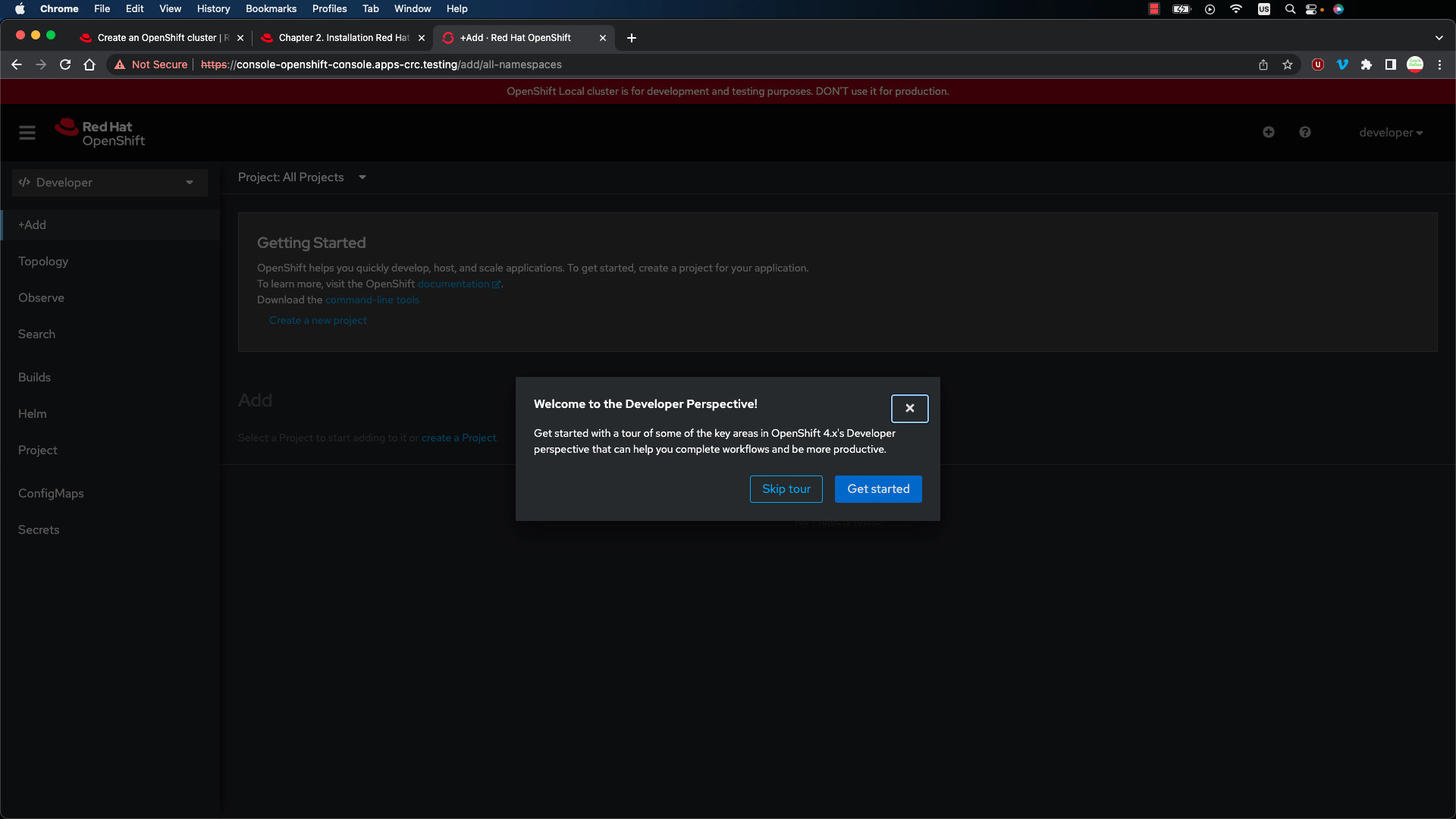
cluster WebUI
The server is accessible via web console at: https://console-openshift-console.apps-crc.testing
cluster stop
ansible-pilot $ crc stop
INFO Stopping kubelet and all containers...
INFO Updating kernel args...
INFO Stopping the instance, this may take a few minutes...
Stopped the instance
ansible-pilot $ crc status
CRC VM:          Stopped
OpenShift:       Stopped (v4.11.3)
Podman:
Disk Usage:      0B of 0B (Inside the CRC VM)
Cache Usage:     36.85GB
Cache Directory: /Users/lberton/.crc/cache
ansible-pilot $
cluster restart
ansible-pilot $ crc stop
INFO Stopping kubelet and all containers...
INFO Updating kernel args...
INFO Stopping the instance, this may take a few minutes...
Stopped the instance
ansible-pilot $ crc status
CRC VM:          Stopped
OpenShift:       Stopped (v4.11.3)
Podman:
Disk Usage:      0B of 0B (Inside the CRC VM)
Cache Usage:     36.85GB
Cache Directory: /Users/lberton/.crc/cache
ansible-pilot $ crc start
INFO Checking if running as non-root
INFO Checking if crc-admin-helper executable is cached
INFO Checking for obsolete admin-helper executable
INFO Checking if running on a supported CPU architecture
INFO Checking minimum RAM requirements
INFO Checking if crc executable symlink exists
INFO Checking if running emulated on a M1 CPU
INFO Checking if vfkit is installed
INFO Checking if old launchd config for tray and/or daemon exists
INFO Checking if crc daemon plist file is present and loaded
INFO Loading bundle: crc_vfkit_4.11.3_arm64...
INFO Starting CRC VM for openshift 4.11.3...
INFO CRC instance is running with IP 127.0.0.1
INFO CRC VM is running
INFO Configuring shared directories
INFO Check internal and public DNS query...
INFO Check DNS query from host...
INFO Verifying validity of the kubelet certificates...
INFO Starting kubelet service
INFO Waiting for kube-apiserver availability... [takes around 2min]
INFO Waiting for user\'s pull secret part of instance disk...
INFO Starting openshift instance... [waiting for the cluster to stabilize]
INFO Adding crc-admin and crc-developer contexts to kubeconfig...
Started the OpenShift cluster.
The server is accessible via web console at:
  https://console-openshift-console.apps-crc.testing
Log in as administrator:
  Username: kubeadmin
  Password: zc3Qx-ejEii-KALgK-5pbYU
Log in as user:
  Username: developer
  Password: developer
Use the 'oc' command line interface:
  $ eval $(crc oc-env)
  $ oc login -u developer https://api.crc.testing:6443
ansible-pilot $ crc status
CRC VM:          Running
OpenShift:       Degraded (v4.11.3)
Podman:
Disk Usage:      16.39GB of 32.74GB (Inside the CRC VM)
Cache Usage:     36.85GB
Cache Directory: /Users/lberton/.crc/cache
See also: Install Red Hat CodeReady Containers to run OpenShift 4 in macOS
Conclusion
Now you know how to install Red Hat OpenShift Local (formerly CodeReady Containers) in macOS and how to manage the OpenShifft 4 cluster, start, stop, restart, and status.
System Requirements
| Requirement | Intel Mac | Apple Silicon Mac | |---|---|---| | CPU | 4 physical cores | 4 performance cores | | RAM | 9 GB free | 9 GB free | | Disk | 35 GB free | 35 GB free | | macOS | 12+ (Monterey) | 12+ (Monterey) |
See also: AAP 2.6 Install Guide: Containerized, RPM & OpenShift Methods (2026)
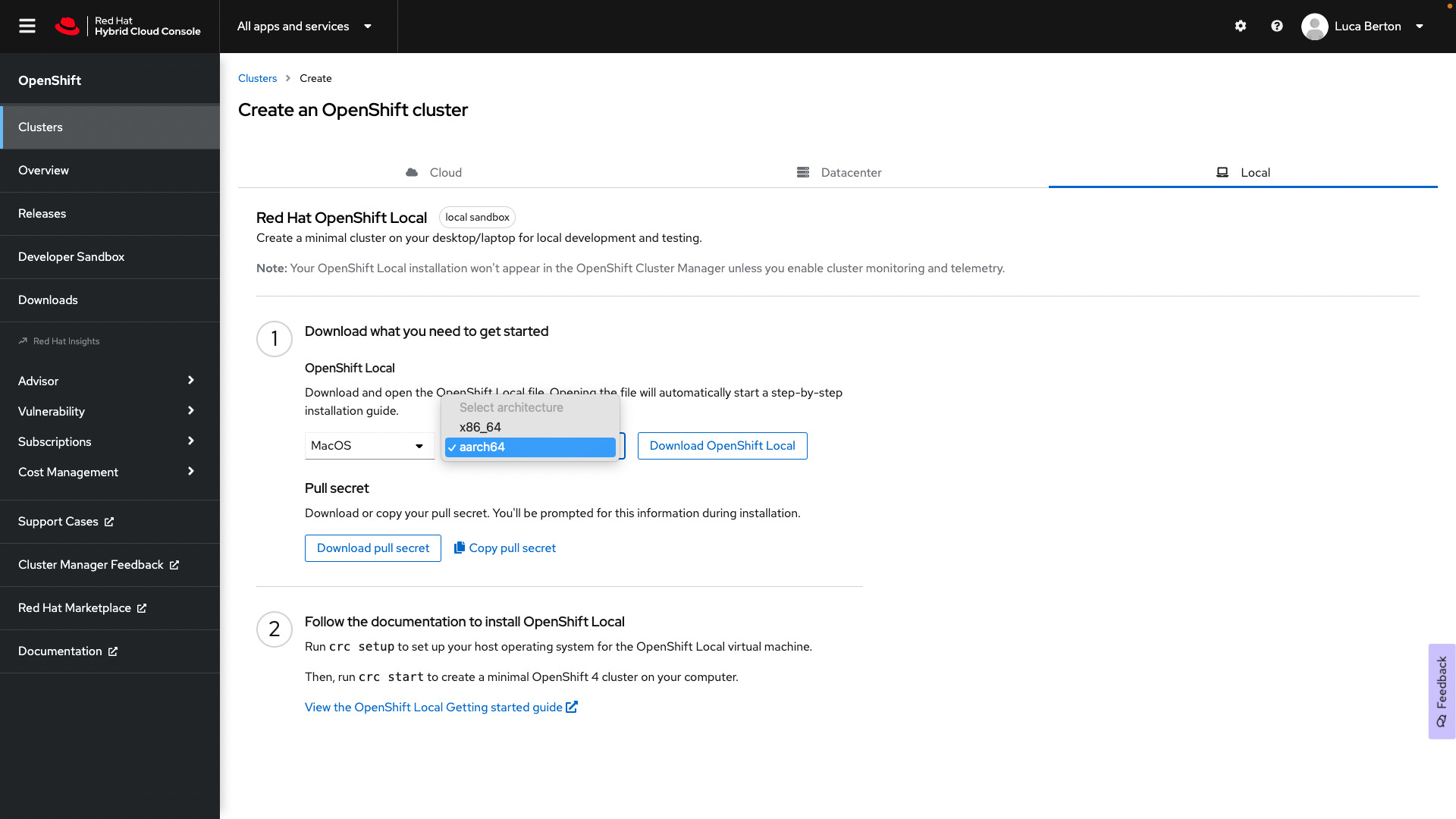
Quick Start
# Download from https://console.redhat.com/openshift/create/local
# Setup (one-time)
crc setup
# Start the cluster
crc start
# Configure CLI tools
eval $(crc oc-env)
# Login
oc login -u developer -p developer https://api.crc.testing:6443
# Open web console
crc console
Managing OpenShift Local with Ansible
Use the kubernetes.core collection to manage resources on your local cluster:
---
- name: Deploy app to OpenShift Local
  hosts: localhost
  connection: local
  collections:
    - kubernetes.core
  tasks:
    - name: Create project
      kubernetes.core.k8s:
        state: present
        definition:
          apiVersion: project.openshift.io/v1
          kind: Project
          metadata:
            name: ansible-demo
- name: Deploy a pod
      kubernetes.core.k8s:
        state: present
        namespace: ansible-demo
        definition:
          apiVersion: v1
          kind: Pod
          metadata:
            name: test-pod
          spec:
            containers:
              - name: ubi
                image: registry.access.redhat.com/ubi9/ubi-minimal
                command: ["sleep", "infinity"]
See also: Ansible troubleshooting - Kubernetes K8s or OpenShift OCP 401 Unauthorized
Troubleshooting
| Issue | Solution |
|---|---|
| crc start fails with memory error | Increase memory: crc config set memory 12288 |
| DNS resolution fails | Run crc cleanup then crc setup again |
| Cluster won't start after macOS update | Run crc delete then crc start for fresh cluster |
| Apple Silicon performance issues | Ensure Rosetta 2 is installed: softwareupdate --install-rosetta |
FAQ
Does OpenShift Local work on M1/M2/M3/M4 Macs?
Yes. OpenShift Local has native Apple Silicon support since version 2.12. Earlier versions required Rosetta 2.
Can I run AWX on OpenShift Local?
Yes for development/testing. AWX requires at least 12 GB RAM allocated to CRC: crc config set memory 12288.
How is OpenShift Local different from Minikube or Kind?
OpenShift Local runs a full OpenShift cluster (including the web console, operators, and routes), while Minikube and Kind run plain Kubernetes.
Is OpenShift Local free?
Yes. You need a free Red Hat account to download it, but no subscription is required.
Related
For a production-focused walkthrough, see Luca Berton's guide on Ansible Kubernetes day-2 operations.
Category: installation
Watch the video: Install Red Hat OpenShift Local Kubernetes in macOS on MacBook Pro Intel x86_64 and M1 arm64 — Video Tutorial